The peaks of Karisimbi, Bisoke, and Sabyinyo rose above the clouds, their silhouettes appearing and disappearing in the changing light. Beneath them stretched one of Africa’s most remarkable landscapes an ancient forest where mountain gorillas, golden monkeys, forest elephants, and generations of local communities have shared a fragile connection for centuries.
Morning arrived quietly.
Along narrow village roads, farmers began their daily walk toward terraced fields. Smoke curled from kitchen fires. Children’s voices carried through the cool mountain air. Life unfolded beneath the mountains much as it had for generations. Far beyond the cultivated hills, another world was awakening.
Hidden within dense bamboo forests, a gorilla family was beginning its day.
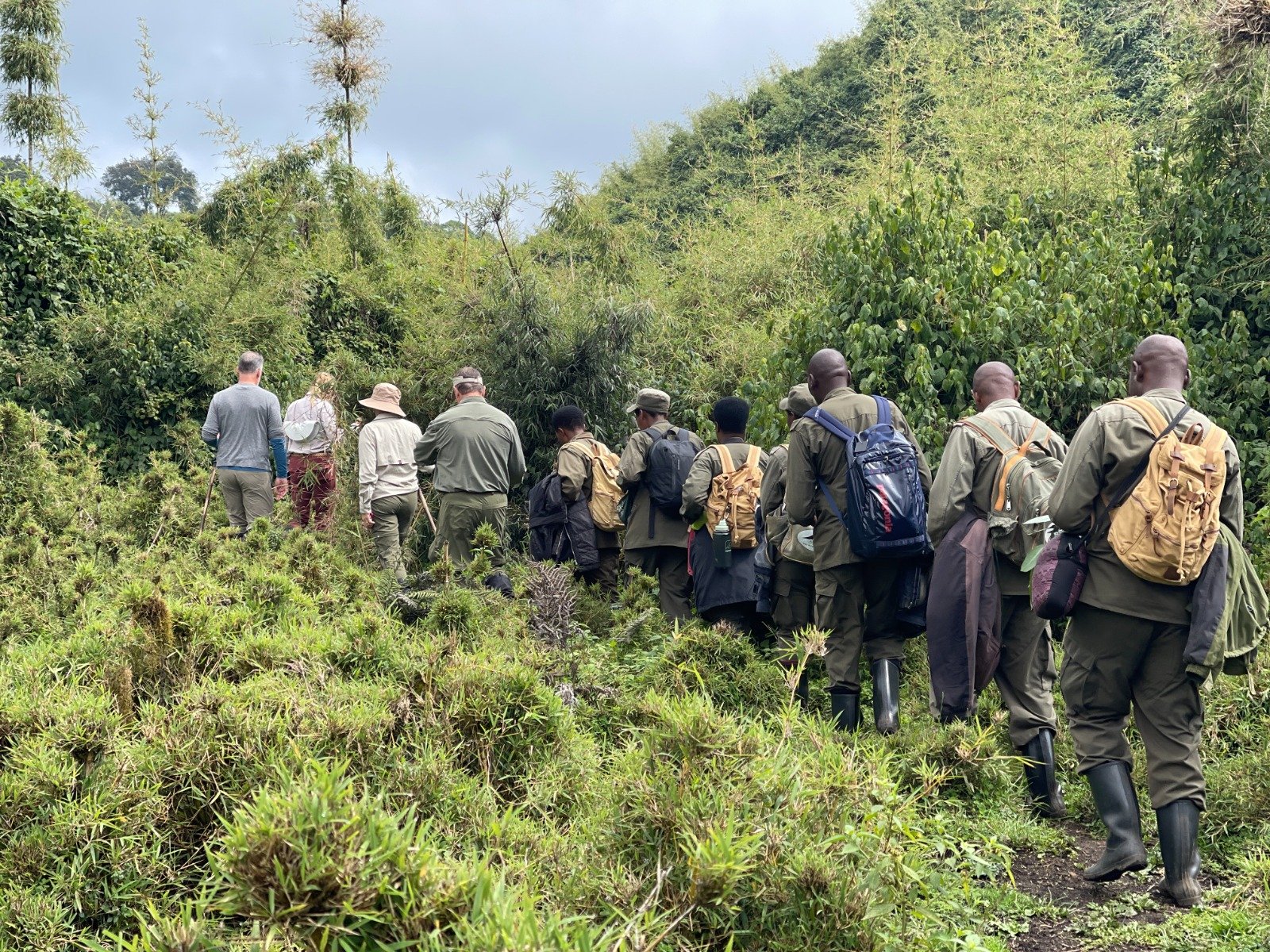
The journey into Volcanoes National Park started shortly after sunrise. The trail climbed steadily through farmland before disappearing beneath a canopy of towering vegetation. With every step, the sounds of village life faded behind us.
Silence took their place.
Not an empty silence, but one filled with movement, birdsong, distant rustling leaves, and the quiet rhythm of a living forest. Emmanuel, a local guide who had spent years walking these slopes, paused beside a cluster of bamboo. “The forest always speaks first,” he said softly. “You simply need to listen.” His words seemed almost poetic until the forest began revealing itself. Fresh footprints pressed into damp soil. Broken stems. Recently disturbed vegetation. Signs invisible to most visitors became a clear story for those who understood the language of the mountains. Ahead, a ranger moved carefully through the vegetation. His presence reflected a larger story woven into every gorilla trek. Several decades ago, mountain gorillas faced an uncertain future. Habitat loss, poaching, and conflict placed enormous pressure on their survival. Today, their population represents one of conservation’s most encouraging achievements a result of scientific research, dedicated protection, responsible tourism, and the commitment of communities living alongside the forest. The trail narrowed. Conversation faded. Then came a sudden gesture from the tracker ahead. Stop. Everyone froze. Leaves shifted gently. Branches swayed. A dark figure emerged through the green. A silverback. Massive. Calm. Completely at ease. He sat among the vegetation with an authority that required no display of strength. The forest seemed to bend around his presence. Then he looked up. His eyes met ours. Everything else disappeared. There are moments during travel that resist explanation. Moments that photographs cannot fully contain. This was one of them. His gaze carried neither fear nor curiosity. It felt older than that. Patient. Observant. Almost familiar. Nearby, a juvenile gorilla climbed through the branches before tumbling playfully back toward the group. A mother adjusted her infant with remarkable gentleness. Another family member moved quietly through the undergrowth searching for food. The scene felt strikingly ordinary. And perhaps that was what made it extraordinary. The gorillas were not performing for visitors. They were simply living. For one hour, the boundary between observer and observed seemed to dissolve. The experience was not defined by action. It was defined by presence. Later, descending from the forest, the wider meaning of the encounter became clearer. The gorillas existed because an entire network of people had chosen protection over exploitation. Guides. Rangers. Researchers. Porters. Families living beneath the mountains. Community tourism initiatives, conservation programs, and responsible travel have helped transform the relationship between people and wildlife across the region. The success of mountain gorilla conservation is not solely a wildlife story. It is a human story. A story of shared responsibility. A story of coexistence. As evening settled across the Virunga Mountains, clouds gathered once more around the volcanic peaks. The forest disappeared behind a curtain of mist. Yet one memory remained. Not the photographs. Not the trek itself. But a single moment of connection. A silverback lifting his eyes from the forest floor. And the feeling, however brief, of being recognised by something wild, ancient, and profoundly alive.

Virunga Editorial Team
We write practical travel stories and local insight guides to help guests get the most meaningful experiences in Northern Rwanda.
Book This Experience
Fill out the form below or contact us on WhatsApp to lock in your reservation.